
Typical Inherent Flow Characteristic: Quick Opening
Most plug valves (including many 3-way designs) are primarily intended for on/off or switching service, not precision throttling. Because of this, their inherent flow characteristic usually resembles a quick-opening curve:
-
①Large percentage of total flow is achieved at small opening angles
-
②Flow increases rapidly during initial opening
-
③Flow change becomes smaller as valve approaches full open
Quick-opening valves deliver most of the flow early in the stroke and are commonly used where flow must be established rapidly, especially in isolation or switching applications.
From a practical standpoint:
-
①0–30% opening → Large flow jump
-
②30–100% opening → Flow increases slowly
-
③Excellent for fast switching, not ideal for fine control
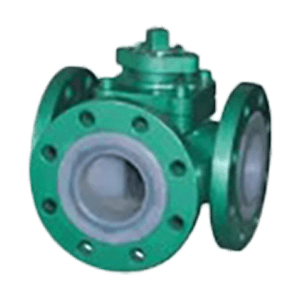
Flow Behavior Specific to 3-Way Plug Valves
Mixing Type (Two Inlets → One Outlet)
Typical behavior:
-
①One inlet gradually decreases while the other increases
-
②Total outlet flow may stay relatively stable
-
③Not linear unless specially profiled
Diverting Type (One Inlet → Two Outlets)
Typical behavior:
-
①Flow shifts from one outlet to another as plug rotates
-
②Intermediate positions may split flow between outlets
-
③Often used more like a selector than a control valve
Special Cases (Engineered 3-Way Plug Valves)
Some manufacturers design:Characterized ports.V-port style plug modifications
These can produce:Near linear flow.Better modulation.But these are less common in marine and general industrial plug valve use.
In Marine & Industrial Real Applications
-
①Fuel oil transfer switching
-
②Cooling water routing
-
③Tank selection systems
-
④Pump suction changeover
-
⑤Emergency bypass lines
In these systems, fast switching and reliability matter more than fine flow control — which is why quick-opening behavior is acceptable and even preferred.
Post time: Feb-05-2026